Introduction: A Rare Artist Who Led Her Era
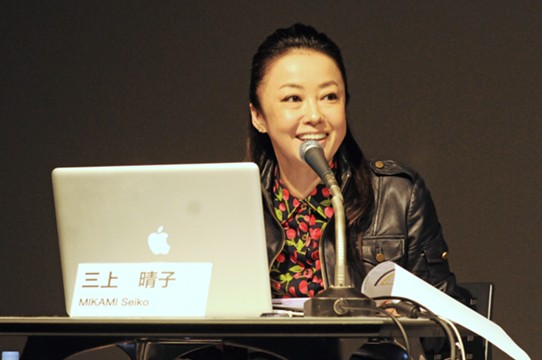
Seiko Mikami (January 8, 1961 – January 2, 2015) was an artist who left an exceptional presence in the world of Japanese media art. Beginning with junk art using scrap metal in the 1980s, she became a pioneer of interactive installations from the 1990s onward, receiving high acclaim both domestically and internationally.
Although she passed away at the young age of 53, the body of work she left behind continues to question the relationship between technology and humanity. 2025 marks the 10th anniversary of her death, and with memorial exhibitions being held at the NTT InterCommunication Center and iwao gallery, there is growing momentum for reassessing her legacy.
Early Career: 1980s Junk Art and the Tokyo Culture Scene
From Shizuoka to Tokyo
Born in Shizuoka Prefecture, Mikami moved to Tokyo after graduating from high school and became involved in editing the cassette magazine “TRA” while also writing art criticism. During this period, she was deeply influenced by alternative cultures such as cyberpunk, noise, and industrial music.
1984: Beginning Performance Activities
From 1984, Mikami began performances using objects made from scrap metal, concrete fragments, and other waste materials. Notably, she performed with a stellar lineup of artists including Nam June Paik, Ryuichi Sakamoto, Haruomi Hosono, and Hajime Tachibana in “Six Performers Around Nam June Paik.” This brought Mikami sudden attention as a glamorous presence in Tokyo’s art scene.
1985: The Shocking First Solo Exhibition “New Plasticity of Destruction”
In May 1985, she held her first solo exhibition “New Plasticity of Destruction” at the former Sapporo Beer Ebisu Factory site. This exhibition, composed of works evoking a ruined city after nuclear war, created a major sensation. After the exhibition, she was featured in the Asahi Journal series “Tetsuya Chikushi’s Youth Exploration: Standard-Bearers of the New Human Race,” attracting media attention.
1986 Onward: From Body to Information
In 1986, she was in charge of stage design for the final performance of “Walpurgis” by the Tokyo Grand Guignol theater company led by Norio Ameya. Subsequently, she presented objects and installations using cables reminiscent of nerves and brains, and computer circuit boards in exhibitions such as “BAD ART FOR BAD PEOPLE” (1986) and “Brain Technology” (1988).
During this period, against the backdrop of urban infrastructure transitioning from analog to digital, Mikami’s work likened telephone cables to nervous systems and shifted themes toward non-material information, including the brain and computers, body and immunity.
1990s: To New York and Transformation into Media Art
Training in America
In 1991, she moved to the United States and majored in computer science at the Graduate School of Information Science, New York Institute of Technology (completed in 1995). During this period, while learning computer science herself, Mikami built an exceptional career for an artist, including working as a researcher at Bell Laboratories.
During this time, she proposed media art as “Bio-Informatics,” crossing biology and information, incorporating themes such as artificial intelligence, computer viruses, and networks into her work.
As a Pioneer of Interactive Art
In 1991, “Pulse Beat – Please Lend Me Your Pulse” at P3 alternative museum, tokyo became her first presentation of participatory interactive art. This format, which barely existed at the time, became the starting point for Mikami’s signature theme of “interface through perception.”
Birth of Major Works
1996: Eye-Tracking Works “Molecular Informatics: Morphogenic Substance via Eye Tracking,” created at Canon Art Lab, was a work using eye-tracking technology, which was cutting-edge at the time.
1997: Works Using Auditory and Internal Body Sounds “Existence, Membrane, Severed Body,” which became a permanent installation at the NTT InterCommunication Center [ICC], is one of Mikami’s representative works. This groundbreaking piece used auditory and internal body sounds to make viewers confront their own perception.
International Recognition
Throughout the 1990s, Mikami presented numerous works primarily in Europe and America. Her works were exhibited at major media art festivals and contemporary art museums worldwide, including the Dutch Electronic Art Festival [DEAF] (Rotterdam), Miró Museum (Barcelona), Nantes Museum of Art (France), “Transmediale” (Berlin), and Ars Electronica (Linz).
The Spanish publisher Diputacion Provincial De Malaga also published a collection of Mikami’s works.
2000s: Educational Activities and Mature Period Works
Educational Work at Tama Art University
From 2000, Mikami became a professor in the Media Arts Course, Information Design Department, Faculty of Art and Design at Tama Art University. She devoted herself to nurturing the next generation of media artists, balancing creative activities as an artist with educational work while constantly pursuing cutting-edge expression.
Collaboration with Yamaguchi Center for Arts and Media [YCAM]
From the 2000s onward, YCAM became an important partner for Mikami. A series of works commissioned by YCAM became masterpieces representing her mature period.
2005: “gravicells – gravity and resistance” This work, created in collaboration with Sota Ichikawa, is an innovative installation that perceives gravity as a “sixth sense.” Viewers find themselves confronting gravity, a sensation usually unconscious, in darkness.
2010: “Desire of Codes” “Desire of Codes,” expressing physicality and desire in an information society, was commissioned for a solo exhibition at YCAM. The mechanism whereby multiple surveillance cameras and sensors track viewers’ movements and the information is reflected in the work in real-time sharply questions the issues of surveillance and privacy in contemporary society.
Cultural Affairs Agency Media Arts Festival Excellence Award
In 2013, Mikami received the Cultural Affairs Agency Media Arts Festival Excellence Award, officially recognizing her contributions to Japan’s media art world.
Seiko Mikami’s Artistic World: Consistent Themes and Evolution of Expression
The Lifelong Theme of “Information Society and the Body”
The theme running through Mikami’s work was “information society and the body.” From junk art in the 1980s to interactive works from the 1990s onward, while the forms of expression changed dramatically, she remained remarkably consistent in her critical approach to networks of information crossing bodies, cities, nations, and computers, and issues surrounding boundaries.
The Vision of a “Museum of Perception”
As Mikami herself wrote, “The eye is not merely for seeing, the ear is not merely for hearing. That is, it is possible to see with the ear, hear with the nose, and touch with the eye.” She used media technology to create experiences where viewers were forced to confront their own perception and interaction mechanisms.
Her goal was to synthesize these into the construction of a “Museum of Perception (or Grand Mausoleum).” Though this grand vision was not realized due to her sudden death, the body of work she left shows a glimpse of it.
Interest in Boundaries and Membranes
Self and other, inside and outside, human and non-human, organic and inorganic – Mikami’s work always stood on boundary lines, attempting to visualize their fluctuations. The boundaries expressed through the words membrane and coating were not fixed for her but constantly fluctuating and transforming.
January 2, 2015: Sudden Death and Aftermath
Sudden News of Death
On January 2, 2015, Seiko Mikami died of cancer. She was 53 years old. This happened just as she was still full of creative ambition and considering new works using drones and AI.
Her sudden death was a great loss to Japan’s media art world. However, the works and ideas she left behind continue to influence many people today.
Preservation and Regeneration of Works
Mikami was extremely proactive about updating her works with the latest technology whenever there was an exhibition opportunity. Carrying on this spirit, repairs and partial recreations have been conducted even after her death by YCAM and those involved in the original production.
Through joint research by Tama Art University and YCAM, new methodologies specific to media art are being verified and explored regarding the preservation not only of works but also of viewer experience data and other materials related to Mikami’s works.
Growing Momentum for Reassessment
During her lifetime, Mikami had discarded many of her works from the 1980s to 90s. However, following her sudden death in 2015, there has been growing momentum for reassessment even in the field of contemporary art, with four works created in the early 1990s being acquired by the Museum of Contemporary Art Tokyo in recent years.
10 Years After Death: 2025 Memorial Exhibitions
Exhibition at NTT InterCommunication Center [ICC]
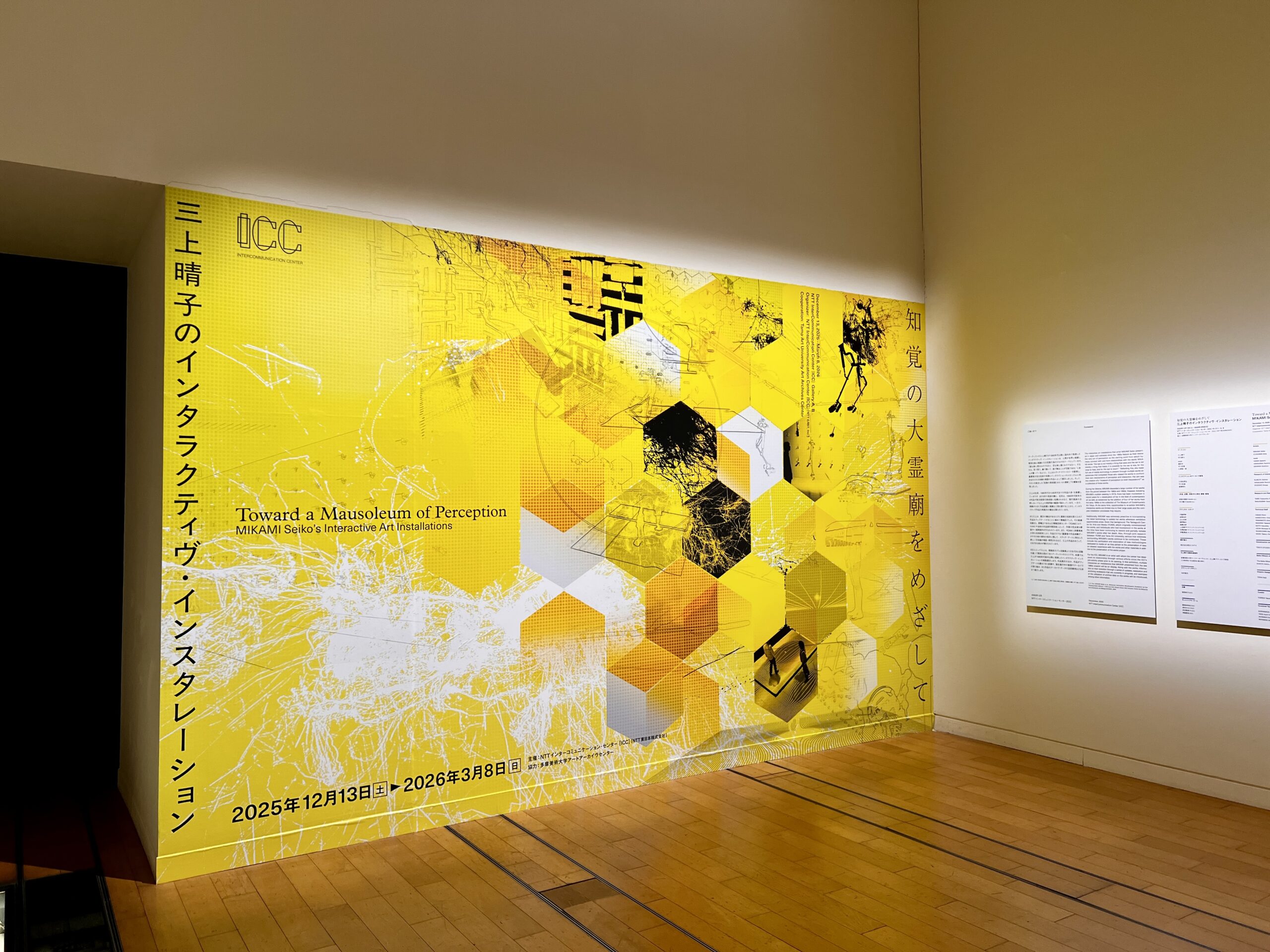
From December 13, 2025 to March 8, 2026, the exhibition “Towards the Grand Mausoleum of Perception – Seiko Mikami’s Interactive Installations” is being held at ICC. This is the first opportunity domestically and internationally to simultaneously exhibit three of Mikami’s large-scale installation works.
Exhibited works:
- “Existence, Membrane, Severed Body” (1997)
- “gravicells – gravity and resistance” (2004/2010)
- “Eye-Tracking Informatics” (2011/2019)
- “Desire of Codes” (2010/2011)
This exhibition introduces not only the works themselves but also the transitions of works through repeated updates and ongoing restoration and archiving efforts.
Exhibition at iwao gallery
From April 24 to 27, 2025, “PLANTS/BOTANICAL Seiko Mikami 10th Anniversary Exhibition” was held at iwao gallery. Centering on works from the 1980s that were rarely shown during her lifetime, handmade iron flower vases and framed botanical paintings discovered in her room after her death were also exhibited, reflecting on her lifelong unchanged devotion to junk and plants.
What Seiko Mikami Questions in Our Contemporary Era
The Relationship Between Technology and Humanity
In the 2020s, as AI rises and the metaverse and VR become everyday realities, the questions Mikami posed more than 20 years ago – what should be the relationship between technology and human physicality and perception – are becoming increasingly important.
A Warning About Surveillance Society
The surveillance camera tracking system shown in “Desire of Codes” seems to have foreseen today’s digital surveillance society. In the contemporary era where our actions are constantly tracked through smartphones and social media, the message of this work becomes all the more urgent.
Blurring of Boundaries
Human and machine, real and virtual, self and other – in contemporary society where all boundaries are becoming ambiguous, the issues of “boundaries” and “membranes” that Mikami explored continue to offer us profound insights.
Conclusion: The Legacy of a Unique Artist
Curator Yukiko Shikata describes Seiko Mikami as “so uniquely singular an artist that one can only express it as ‘Seiko Mikami was Seiko Mikami.'” She was a person who did not fit within the frameworks of existing genres, conventions, and systems, a rare being with keen intuition and excellent ability to connect it to practice.
During her lifetime, Mikami never championed feminism. However, in her way of life there was an affirmation of life and creation based on difference, transcending gender and various boundaries.
Seiko Mikami keenly observed the movements of the times and continued to question through her works the future of new technology and humanity (the posthuman future). The body of work she left behind continues to pose important questions to us today.
Now, 10 years after her death, encountering Seiko Mikami’s work anew is not merely retrospective but an opportunity to think about our own future. The “adventure of perception” that her works present will continue to fascinate and inspire many people.









コメント